Brief Overview:
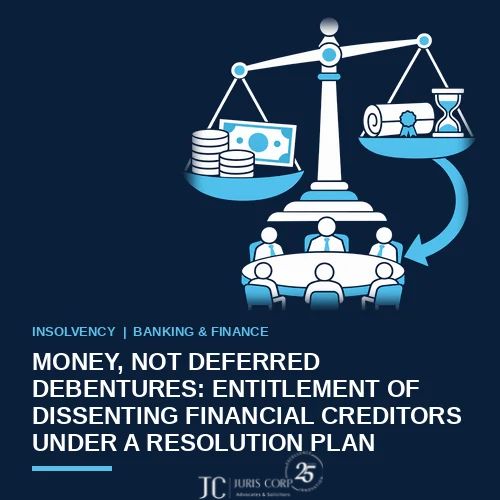
Whether a resolution plan which proposes payment to dissenting financial creditors (“DFCs”) through long-term redeemable non-convertible debentures (“NCDs”) complies with Section 30(2)(b) of the Insolvency and Bankruptcy Code, 2016 (“IBC”)? No!
Whether a legally non-compliant resolution plan can be remanded back to the Committee of Creditors (“CoC”)? Yes!
Technical Details:
1) Payment contemplated under Section 30(2)(b) of IBC to DFCs must be payment in money, and not anything of its equivalent in barter.
2) NCDs redeemable over the years do not constitute “payment” as required under Section 30(2)(b) of IBC.
3) NCLT cannot cure such a legal defect by directing upfront cash payment to DFCs. Such a direction amounts to modification of a resolution plan.
4) The CoC does not become functus officio immediately upon approving a resolution plan.
5) A resolution plan can be remanded back to the CoC but: (a) it should be in furtherance of the objectives of IBC; (b) based on a legal non-compliance; (c) must be exercised sparingly and be accompanied with strict direction to adhere to timelines.
6) Foreign assets held through overseas subsidiaries (even wholly owned ones) do not automatically form part of the parent company’s insolvency.
Takeaways:
Debentures cannot substitute ‘payment’ contemplated under Section 30(2)(b) of IBC to DFCs. A legally non-compliant resolution plan cannot be fixed by NCLT/NCLAT through directions. Such a plan can be set aside and remanded back to the CoC for reconsideration, thereby preserving the primacy of the CoC’s commercial wisdom while ensuring compliance with statutory requirements.
For further details, please see:
Twinstar Technologies Limited v. Bank of Maharashtra & Ors.
For any queries/clarifications, please feel free to ping us and we will be happy to chat: