Brief Overview:
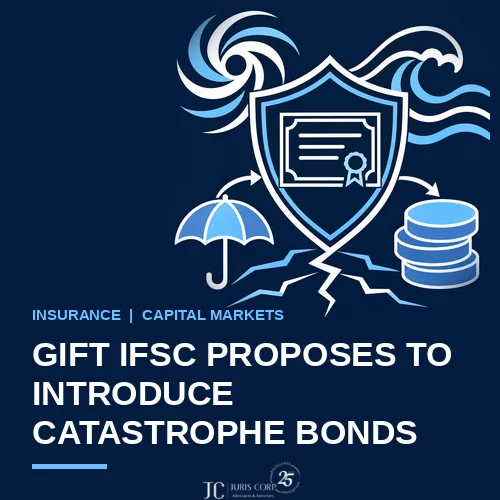
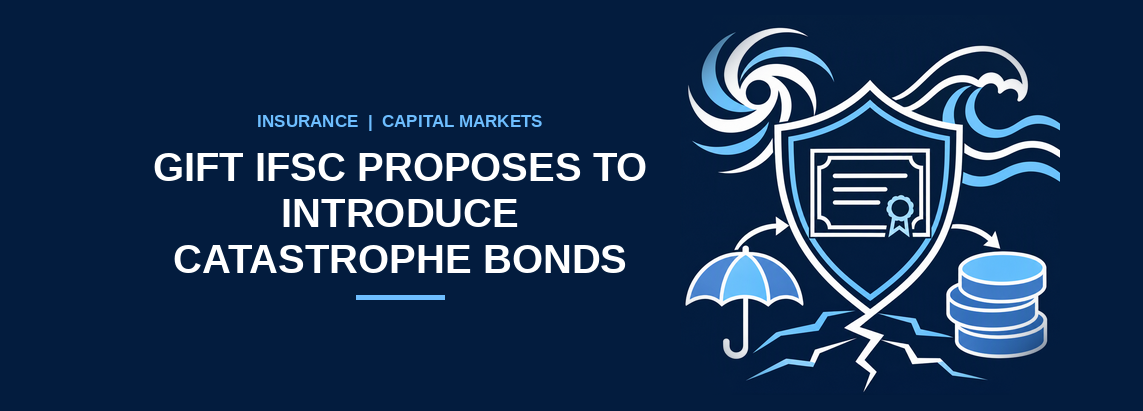
A catastrophe bond (or CAT Bond) is an insurance-linked security through which institutional capital is deployed for disaster-risk financing. It enables insurers and reinsurers to transfer specified catastrophe risks to capital-market investors.
On 16th November 2026, the International Financial Services Centres Authority (IFSCA) published the Report of the Working Group on Developing a Framework for Issuance of Insurance-Linked Securities (ILS) from GIFT IFSC.
Technical Details:
What are CAT Bonds?
CAT Bonds transfer the risk associated with specified catastrophic events from insurers and reinsurers to investors. In consideration for assuming such risk, investors receive a contracted coupon if the specified event, such as an earthquake, flood or cyclone, does not occur.
If the specified event occurs and the conditions of the bonds are triggered, investors may lose part or all of their investment, which is then applied towards meeting the resulting losses. In this manner, insurance risk is transformed into an investible financial instrument.
The proposed ILS framework is not intended to replace conventional reinsurance arrangements. Instead, it seeks to provide insurers and reinsurers with an additional source of risk-transfer capacity.
CAT Bonds would be issued by a Special Purpose Insurer (SPI), which would assume the relevant risk from an insurer or reinsurer seeking protection. The proceeds raised by the SPI through the issuance of CAT Bonds would serve as collateral and would be held by the SPI. If the specified catastrophic event occurs and the specified event is triggered, the collateral would be applied towards meeting the SPI’s obligations to the insurer or reinsurer. If the specified event is not triggered, the principal would be returned to investors together with the agreed returns.
For the introduction of ILS, including CAT Bonds, in India, the Working Group has made the following key recommendations:
1) SPIs should be recognised under the legal framework of the Insurance Act, 1938.
2) SPIs should be exempted from the capital requirements ordinarily applicable to insurers under the Insurance Act, 1938, given that they would maintain collateral for the risks assumed, in line with global standards.
3) The ILS framework should prescribe requirements relating to bankruptcy remoteness, trigger mechanisms, valuation, monitoring and ring-fencing of collateral, among other matters.
4) The framework should identify the intermediaries involved in ILS transactions and clearly set out their respective roles and responsibilities.
Takeaways:
Given India’s exposure to an increasing number of catastrophic events, the introduction of CAT Bonds, in line with global market practices, could provide an additional source of disaster-risk financing and attract international capital to India.
As the unified regulator for financial products, capital markets and insurance in GIFT IFSC, IFSCA is well placed to facilitate the introduction and regulation of ILS.
The proposed framework could enable GIFT IFSC to develop new avenues for risk financing in India and increase participation by global investors in the Indian market.
For further details, please see:
Report of working Group on developing a framework for issuance of Insurance-Linked Securities (ILS)
For any queries/clarifications, please feel free to ping us and we will be happy to chat: