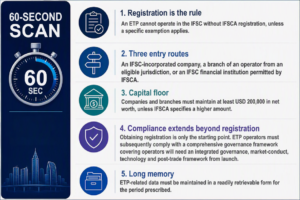
At a glance. GIFT IFSC now has a dedicated framework for institutional electronic trading platforms (ETPs), moving market participants away from the earlier reliance on the RBI’s ETP framework and culminating IFSCA’s broader effort to develop a standalone regime through consultations and draft regulations. The regulations create a clearer route to market but raise immediate structural and operational questions. Prospective operators must determine whether registration is required, identify the available entry route and test whether their proposed legal, operational and technological model can meet IFSCA’s requirements
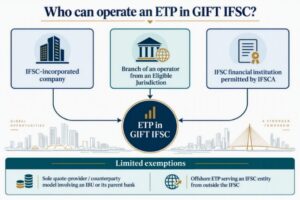
Who can operate in IFSC?
The Regulations provide multiple routes for operating an ETP in the IFSC, while retaining targeted exemptions for certain banking and offshore models. The available entry routes and the circumstances in which registration may not be required are illustrated below.
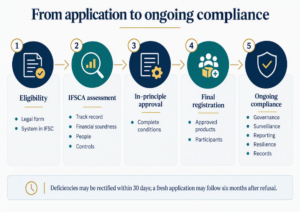
If IFSCA identifies deficiencies in an application, the applicant may be given 30 days to rectify them and make written submissions. If registration is refused, a fresh application may be made after six months.
From consultation draft to final framework
| Issue | Final position | Why it matters? |
| Minimum net worth | Reduced from USD 250,000 to USD 200,000 | Lowers the entry threshold while retaining a prudential floor. |
| Approval process | In-principle approval introduced | Allows staged regulatory clearance before final launch. |
| Eligible Jurisdictions | Hong Kong removed; six jurisdictions remain | Narrows the branch-route perimeter. |
| Operating Policy | Material changes require regulatory intimation rather than prior approval | Offers more operating flexibility, subject to visibility for IFSCA. |
| Market conduct | Enhanced market-abuse reporting and algorithmic-access disclosure | Raises surveillance and transparency expectations. |
| Conflicts | Comprehensive conflict-management policy formalised |
Requires documented identification, mitigation, disclosure and oversight |
Application-to-compliance pathway
For prospective operators, the regulatory journey extends well beyond registration. The key stages – from eligibility assessment to ongoing compliance – are summarised below.
Why should the market care?
For institutional trading venues, the framework creates a clearer route into GIFT IFSC and may open access to deeper markets across securities, money-market instruments, foreign exchange and derivatives. The branch route may be particularly attractive to established overseas operators seeking an IFSC presence without establishing a separately capitalised subsidiary. The opportunity is significant, but so are the implementation demands: banks, market makers and fintechs should test their proposed entry structure against the applicable capital, governance, technology and operating requirements before committing to a launch plan.
Are you ready to launch?
- Have you identified the right entry route? Assess whether registration is required or an exemption is available.
- Is your governance framework ready? Ensure appropriate policies, compliance oversight, conflict-management and reporting arrangements are in place.
- Is your technology architecture compliant? Assess whether systems, infrastructure and outsourced components align with IFSC requirements.
- Are your market-conduct controls in place? Establish surveillance, market-abuse monitoring, algorithmic trading controls and incident-reporting mechanisms.
- Are your post-trade arrangements ready? Confirm that clearing, settlement, record-keeping and data-retention frameworks support ongoing compliance.
- Is your operational resilience framework robust? Review cyber security, business continuity, disaster recovery, outsourcing oversight and regulatory engagement processes.
Key takeaway
GIFT IFSC has opened a credible new route for institutional electronic trading platforms-but market access is only the starting point. The decisive question is not whether to enter, but how. Operators that align their entry structure, governance, technology, market-conduct controls and post-trade arrangements at the outset will be best placed to secure approval, control implementation costs and build a scalable platform. In this framework, early regulatory and operational choices will determine whether the opportunity translates into a viable launch.
Authors:

Disclaimer:
This article is intended for informational purposes only and does not constitute a legal opinion or advice. Readers are requested to seek formal legal advice prior to acting upon any of the information provided herein. This article is not intended to address the circumstances of any particular individual or corporate body. There can be no assurance that the judicial / quasi-judicial authorities may not take a position contrary to the views mentioned herein.