Brief Overview:
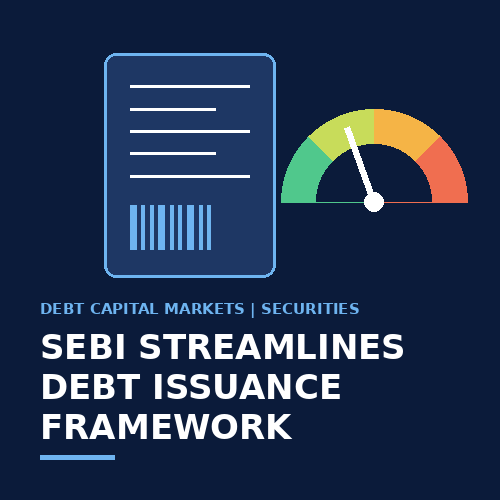
India’s debt market witnesses a regulatory shift towards relaxed issuance norms and strengthening disclosures requirements vide 3 circulars issued by Securities and Exchange Board of India (“SEBI”) on 07th October 2026, comprising of: (a) introduction of a conditional waiver in the requirements for appointment of a Merchant Banker, (b) an increased ISIN limit and (c) introduction of a mandatory disclosure requirement by way of a colour-coded credit risk-o-meter.
Technical Details:
A brief overview of the key changes introduced by SEBI are provided below:
1) Conditional waiver for appointment of a Merchant Banker
Upon satisfying the following conditions, an entity may issue debt securities or non-convertible redeemable preference shares on a private placement basis at a face value of INR 10,000/- without appointing a merchant banker:
(a) It is registered with or regulated by SEBI, RBI, IRDAI or PFRDA.
(b) It has been listed on any segment of a recognised stock exchange for a period of at least 1 year and there is no pending fine or penalty for non-compliance with the LODR Regulations.
(c) No default during the preceding 3 financial years and the current financial year in relation to the repayment, interest or dividend payable in respect of debt securities, non-convertible redeemable preference shares, securitised debt instruments, commercial papers, deposits or loans along with a statutory auditor’s certificate.
(d) The debt securities must be unsubordinated/senior and secured backed by a first or pari passu charge over the assets.
2) Increased ISIN limits
(a) Maximum 17 ISINs maturities in a financial year, with additional 6 ISINs for eligible capital gains tax-saving debt securities issued under Section 85 of the Income-tax Act, 2025 (corresponding to Section 54EC of the Income-tax Act, 1961), on a private placement basis.
(b) Up to 12 ISINs for plain vanilla debt securities, covering issuance of both secured and unsecured debt securities.
(c) 1 (One) additional ISIN for every additional issuance of INR 3,000 Crore (for the Issuers crossing an aggregate outstanding value of INR 15,000 Crore in a financial year).
(d) Maximum 5 ISINs in a financial year for structured debt securities, market-linked debt securities, floating rate bonds, zero-coupon bonds and Tier II bonds.
(e) Maximum 12 ISINs in a financial year, for issuers issuing only structured or market linked instruments.
3) Introduction of a mandatory disclosure requirement by way of colour-coded credit risk-o-meter for credit risk transparency and investor awareness in the (a) offer documents, (b) advertisements of issuers and Online Bond Platform Providers (“OBPPs”), and (c) websites and mobile application of OBPPs.
Takeaways:
SEBI’s latest reforms strike a balance between easing capital raising and enhancing investor protection by providing greater flexibility, reducing compliance burdens for eligible issuers, and introducing stronger credit risk transparency measures.
For further details, please see:
- Exemption from the requirement of mandatory merchant banker appointment for debt issued through private placement by certain listed issuers
- Review of provisions related to International Securities Identification Number (ISIN) for debt securities issued on private placement basis
- Introduction of Credit Risk-o-Meter as an additional disclosure mechanism for debt securities
For any queries/clarifications, please feel free to ping us and we will be happy to chat: