- Introduction
In a significant step toward enhancing the competitiveness of India’s international financial services landscape, the International Financial Services Centres Authority (“IFSCA”), at its
28th meeting held on 17th April 2026, inter alia approved key amendments to the IFSCA (TechFin and Ancillary Services) Regulations, 2025 (“TechFin and Ancillary Services Regulations”) and the IFSCA (Finance Company) Regulations, 2021 (“Finance Company Regulations”), drafts of which were issued by IFSCA for the feedback of public and market participants on 17th March 2026 (“IFSCA Amendments”). The IFSCA Amendments were later notified by IFSCA on 12th May 2026.
The primary objective of the IFSCA Amendments is to enable the establishment of special purpose vehicles (“SPVs”) entirely within GIFT International Financial Services Centres (“GIFT IFSC”), thereby strengthening the leasing and financing ecosystem, particularly in the aircraft leasing sector. By facilitating end-to-end structuring within a single jurisdiction, the amendments aim to position GIFT IFSC as a globally competitive hub for structured finance transactions.
- Structure at a glance
- Enabling SPVs within GIFT IFSC
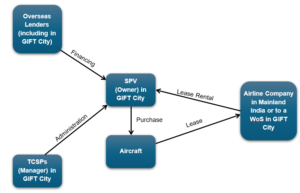
A cornerstone of the regulatory reform is the amendment to the Finance Company Regulations, which now expressly enables the incorporation and registration of SPVs within GIFT IFSC. Under the amended framework, leasing or financing activities carried out by an SPV, as permitted by IFSCA, are recognized as permissible ‘non-core’ activities. This provides finance companies and market participants with the regulatory clarity needed to structure transactions using SPVs without ambiguity.
SPVs are fundamental to structured finance and aircraft leasing transactions, where asset ownership, financing, and leasing arrangements are often segregated across entities for risk management and investor protection. Prior to this amendment, such SPVs were typically established in offshore jurisdictions due to the absence of an enabling framework within IFSC.
Complementing this, the amendments to the TechFin and Ancillary Services Regulations introduce a regime for the registration of Trust and Company Service Providers (“TCSPs”) in GIFT IFSC. TCSPs are authorized to provide essential administrative and fiduciary services, including incorporation, management, and operation of SPVs. Their inclusion ensures that the necessary support infrastructure, such as trustees, corporate administrators, and compliance service providers, is available within the GIFT IFSC.
Together, these changes create a comprehensive ecosystem for structured transactions. While SPVs provide the legal and financial structuring vehicle, TCSPs ensure their operational and regulatory compliance, mirroring the frameworks available in established global financial centres.
- Impact on the Current Regime
The IFSCA Amendments represent a marked shift from the earlier multi-jurisdictional structuring paradigm that characterized aircraft leasing transactions. Historically, different components of a transaction, such as the asset-holding SPV, financing entity, and leasing platform, were often located in separate jurisdictions (e.g., Ireland, Singapore, or the United Arab Emirates), each selected for specific regulatory or tax advantages.
This fragmented approach resulted in increased complexity, higher legal and administrative costs, and coordination challenges across jurisdictions. The inability to house SPVs within GIFT IFSC was a significant limitation, preventing India from capturing the full value chain of leasing transactions.
By enabling SPVs within IFSC, the amendments allow for consolidation of the entire transaction structure within a single jurisdiction. This has several tangible impacts:
- Operational Efficiency: A unified regulatory and legal framework reduces duplication of processes and simplifies transaction execution.
- Cost Reduction: Consolidation significantly lowers legal, compliance, and administrative expenses associated with multi-jurisdictional setups.
- Enhanced Certainty: A single governing regime improves predictability in enforcement, dispute resolution, and regulatory compliance.
- Tax Efficiency: GIFT IFSC offers a favorable tax regime, which, when combined with SPV structuring, enhances the economic viability and global competitiveness of Indian leasing structures.
Additionally, the introduction of TCSPs addresses a critical gap in the GIFT IFSC ecosystem. Previously, the absence of locally regulated service providers necessitated reliance on offshore administrators and trustees. With TCSPs now permitted, GIFT IFSC can support end-to-end transaction management internally, strengthening its institutional depth.
These reforms collectively align India’s international financial services centre framework with global best practices, enabling it to compete more effectively with established aircraft leasing hubs such as Ireland and Singapore.
- Conclusion
The IFSCA Amendments mark a transformative development in the evolution of GIFT IFSC. By enabling SPVs within GIFT IFSC and introducing a regulatory framework for TCSPs, IFSCA has created the foundational infrastructure necessary for a fully integrated leasing and financing ecosystem.
These changes not only address longstanding structural limitations but also significantly enhance the efficiency, cost-effectiveness, and competitiveness of transactions routed through GIFT IFSC. Importantly, they support India’s broader policy objective of onshoring financial services activity and reducing dependence on offshore jurisdictions.
However, a moot question that remains unanswered is whether there are entities in India / GIFT IFSC that have the expertise and more importantly, the capabilities to set-up and administer such SPVs, especially for a nuanced industry like aviation. If the answer to this question is in the affirmative, then the other point of contention is whether market participants have confidence in such entities? If not, then for GIFT IFSC to emerge as a viable and attractive global hub for aircraft leasing and structured finance transactions, supported by a robust, self-sufficient regulatory and operational ecosystem, it is impetrative that the ecosystem presents enough commercial viability for the likes of Walkers, Maples, Appleby, etc. to come set up as a TCSP in GIFT IFSC in order for them to in turn set-up and manage the SPV.
Authors: