Brief Overview:
Whether an arbitration clause contained in one instrument can bind a party through another interconnected instrument that forms part of the same transaction, despite the latter not containing an arbitration clause? Yes.
The Supreme Court binds the personal guarantor to the arbitration clause contained in the loan agreement which was not signed by him.
Technical Details:
1) In case of composite transactions involving multiple agreements, courts must assess whether the agreements are consequential to or follow from the principal agreement.
2) What was different here:
(a) The clauses in the loan agreement – definitions, interpretation, schedules, miscellaneous – were drafted in a manner such that their conjoint reading indicated that the personal guarantee was not standalone, but an integral part of the loan agreement.
(b) The arbitration clause was sharply drafted with the right usage of the defined terms.
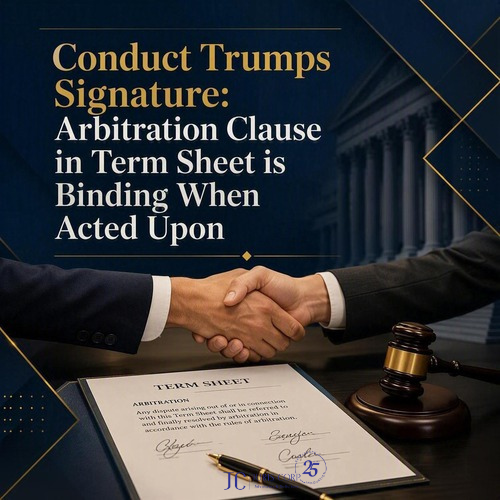
(c) The contemporaneity of execution of the personal guarantee in close proximity to the facility agreements reinforced the inference that the parties intended the entire cluster of documents to constitute a single, composite transaction.
(d) No signature on the loan agreement by the personal guarantor was not decisive if the personal guarantee was explicitly intended to be incorporated in the loan agreement.
Takeaways:
Drafting clauses sharply and timing of execution of the documentation suite can go a long way in binding non-signatories, besides assessing their role in the negotiation, performance and termination of the underlying contract. Courts are increasing looking at the transaction as a whole, beyond individual agreements.
For further details, please see:
For any queries/clarifications, please feel free to ping us and we will be happy to chat: