The United Kingdom has recognised India’s Carbon Credit Trading Scheme (“CCTS”) as a qualifying overseas carbon-pricing mechanism for purposes of the UK Carbon Border Adjustment Mechanism (“UK CBAM”). This is a positive development for Indian exporters, but the benefit is not automatic. Relief will depend on whether the relevant goods fall within UK CBAM, whether an eligible carbon price has actually been borne in India, and whether the UK importer can satisfy the applicable evidence, verification and record-keeping requirements.
1) What Is India’s CCTS?
India’s CCTS is the domestic framework for pricing greenhouse-gas emissions through tradable Carbon Credit Certificates. It has a mandatory compliance mechanism for notified industrial entities and a voluntary offset mechanism for eligible emission-reduction or removal projects.
2) What Is the UK’s CBAM?
The UK CBAM is intended to ensure that specified carbon-intensive imports bear a carbon cost comparable to UK-produced goods and to reduce carbon leakage. It is expected to apply from 1st January 2027 to specified goods in the aluminium, cement, fertiliser, hydrogen, iron and steel sectors.
For UK CBAM relief, the mandatory CCTS mechanism is more directly relevant because it may evidence a carbon cost borne by the installation producing the exported goods. Voluntary offsets should not, by themselves, be assumed to qualify.
3) What the Recognition Means
- Potential reduction in UK CBAM liability: Eligible carbon costs borne under the CCTS may be credited against the UK CBAM charge.
- Lower risk of double carbon pricing: The same emissions may not be priced twice in full – once in India and again at the UK border.
- Commercial advantage for prepared exporters: Exporters with reliable emissions data, CCTS records and verification support may be better placed to reduce landed carbon costs.
The recognition should not be read as a blanket exemption. The amount of relief will depend on the effective carbon price actually paid, the emissions covered, any rebates or compensation, and the UK importer’s ability to meet the prescribed verification and record-keeping standards.
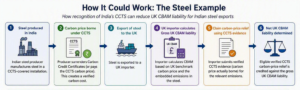
4) How It Could Work: The Steel Example
If an Indian steel producer has borne a verified carbon price under the CCTS, the UK importer may be able to claim carbon-price relief while calculating UK CBAM liability.
Net UK CBAM liability = Gross UK CBAM liability − Eligible verified CCTS carbon-price relief
This may not reduce the UK charge to zero. If the eligible Indian carbon price is lower than the UK benchmark, the importer may still pay the difference. The commercial value will therefore depend on the quality of evidence and the quantum of the verified Indian carbon cost.
5) Why This Matters
For Indian exporters, the development is commercially relevant because carbon costs can affect pricing, competitiveness and customer negotiations in the UK market. The benefit will lie not merely in India’s recognition, but in exporters being able to evidence emissions, carbon costs and compliance in a form that UK importers can rely on.
6) What Exporters Should Do Next
- Confirm whether the exported goods and commodity codes fall within UK CBAM.
- Map product-level embedded emissions to CCTS records and reporting periods.
- Maintain evidence of the effective carbon price paid, including certificates, costs, rebates and compensation.
- Coordinate with UK importers and verifiers on the carbon-pricing verification form and supporting documents.
- Review contracts to allocate responsibility for emissions data, verification costs, CBAM relief and errors.
7) Conclusion
The UK’s recognition of India’s CCTS is a positive step for Indian exporters, but the real benefit will be determined by documentation and execution. Exporters that prepare early – by aligning emissions data, carbon-pricing records, verification processes and contract terms – will be better placed to support UK CBAM relief claims and manage carbon-cost exposure in UK trade.
Authors:

Disclaimer:
This article is intended for informational purposes only and does not constitute a legal opinion or advice. Readers are requested to seek formal legal advice prior to acting upon any of the information provided herein. This article is not intended to address the circumstances of any particular individual or corporate body. There can be no assurance that the judicial / quasi-judicial authorities may not take a position contrary to the views mentioned herein
UK recognises India’s carbon credit scheme under CBAM, easing tax burden for exporters | Today News